
TARGETING BAND 6 (AQA/EDEXCEL) & BAND 8 (CAMBRIDGE)
Written by bunPeiris of Moratuwa.
Language Features & Effect on the Reader or Audience For Cambridge, Edexcel, AQA (OL, AS, AL)
TARGETING BAND 6 (AQA/EDEXCEL) & BAND 8 (CAMBRIDGE)
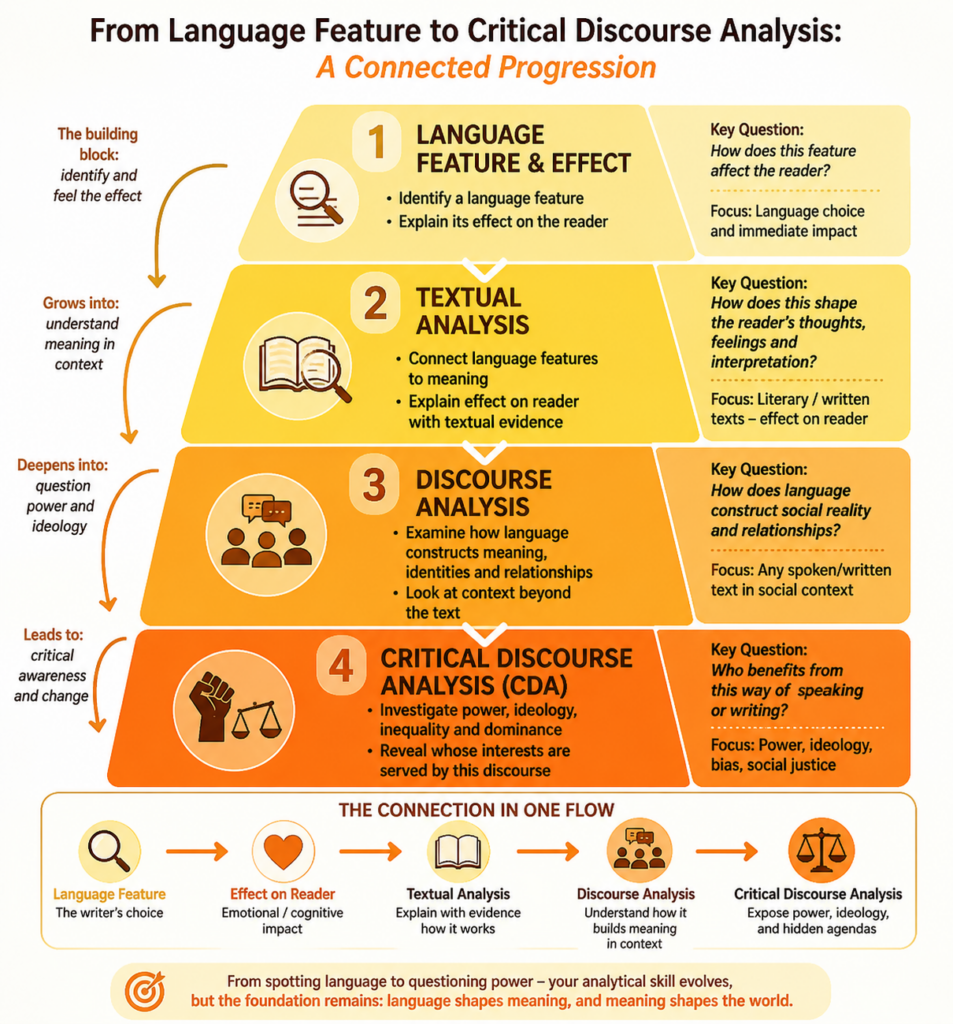
In Cambridge, Edexcel and AQA English Language and Literature examinations (IGCSE and AS/AL), high-band responses require students to analyse how writers use language to shape meaning and influence the reader or audience. This analytical skill is essential for achieving the top bands (Band 6–8) and forms a foundation for advanced academic study, including discourse analysis and critical discourse analysis.
Writers make deliberate choices at word, sound, figurative, grammatical and structural levels. These choices are designed to shape how readers feel, think and respond. Examiners reward analysis of effects, not simply identification of techniques.
High-band responses clearly:
[a] Identify the language feature
[b] Explain how it works
[c] Analyse the effect on the reader
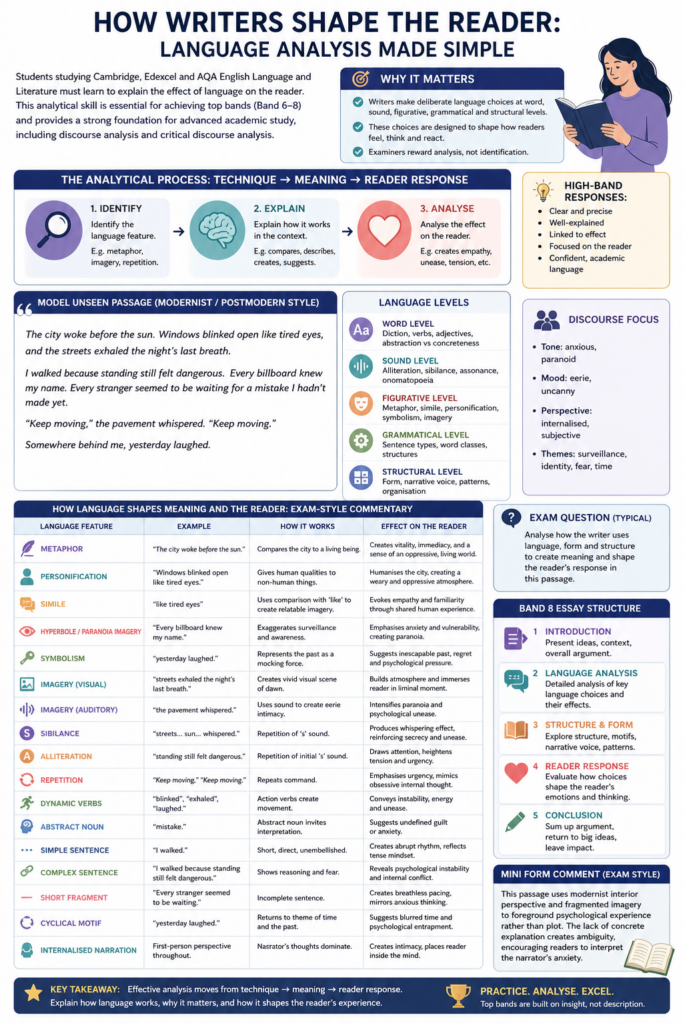
Textual analysis therefore, connects technique →meaning →reader response.
Model Unseen Passage (Modernist/Postmodern style)
Passage
The city woke before the sun. Windows blinked open like tired eyes, and the streets exhaled the night’s last breath.
I walked because standing still felt dangerous. Every billboard knew my name. Every stranger seemed to be waiting for a mistake I hadn’t made yet.
“Keep moving,” the pavement whispered. “Keep moving.”
Somewhere behind me, yesterday laughed.
Commentary in bunPeiris’s DEEP PEEL pattern.
(Language feature + example + linking verb in simple present tense + general effect + linking verb in present participle + specific effect)
LANGUAGE
Metaphor
Example: “The city woke before the sun.”
The metaphor shows cities as living organisms, creating a sense of vitality and immediacy for readers.
Personification
Example: “Windows blinked open like tired eyes.”
Personification highlights the humanisation of the urban setting, portraying the city as weary and oppressive.
Simile
Example: “like tired eyes”
The simile creates relatable imagery, evoking reader empathy and familiarity with exhaustion.
Hyperbole / Paranoia imagery
Example: “Every billboard knew my name.”
Hyperbole emphasises overwhelming surveillance, depicting the speaker’s anxiety and vulnerability.
Symbolism
Example: “yesterday laughed.”
Symbolism suggests the inescapability of the past, illuminating psychological pressure and regret.
Imagery (Visual)
Example: “streets exhaled the night’s last breath.”
Visual imagery builds atmospheric setting, immersing the reader in a liminal dawn moment.
Imagery (Auditory)
Example: “the pavement whispered.”
Auditory imagery creates eerie intimacy, intensifying the sense of paranoia.
SOUND DEVICES
Sibilance
Example: “streets… sun… whispered.”
Sibilance produces a soft whispering sound, reinforcing secrecy and unease.
Alliteration
Example: “standing still felt dangerous.”
Alliteration draws attention to the phrase, heightening tension and urgency.
REPETITION / RHETORIC
Direct speech + Repetition
Example: “Keep moving… Keep moving.”
Repetition emphasises urgency, mimicking obsessive internal thought.
WORD CLASSES
Dynamic verbs
Example: “blinked”, “exhaled”, “laughed.”
Dynamic verbs create movement and energy, conveying instability and unease.
Abstract noun
Example: “mistake.”
Abstract noun invites interpretation, suggesting undefined guilt or anxiety.
GRAMMAR & SENTENCE FEATURES
Simple sentence
Example: “I walked.”
The simple sentence creates abrupt rhythm, reflecting the narrator’s tense mindset.
Complex sentence
Example: “I walked because standing still felt dangerous.”
The complex sentence shows reasoning and fear, revealing psychological instability.
Short sentence fragments
Example: “Every stranger seemed to be waiting.”
Fragmented syntax creates breathless pacing, mirroring anxious thinking.
STRUCTURE
Cyclical time motif
Example: “yesterday laughed.”
Temporal distortion suggests blurred time, highlighting modernist psychological focus.
Internalised narration (modernist trait)
The first-person perspective creates intimacy, placing the reader inside the narrator’s mind.
DISCOURSE FEATURES
Tone — anxious / paranoid
The tone creates tension, making the reader feel unsettled.
Mood — eerie / uncanny
The mood establishes discomfort, immersing the reader in psychological unease.
MINI FORM COMMENT (Exam Style)
This passage uses modernist interior perspective and fragmented imagery to foreground psychological experience rather than plot. The lack of concrete explanation creates ambiguity, encouraging readers to interpret the narrator’s anxiety.
Unseen Passage (Modernist / Postmodern style)
By the time the train arrived, the platform had forgotten why it existed.
Screens flickered with destinations nobody seemed eager to reach. A woman rehearsed a goodbye into her phone, her voice rising and falling like a tide that had lost the moon. Beside her, a boy counted the tiles on the floor as if the right number might unlock something hidden beneath the station.
I checked the time again. It had not changed. It never changed here.
An announcement crackled overhead, dissolving into static halfway through the sentence. People nodded anyway, obedient to words they had not heard. A man in a grey coat laughed too loudly, then glanced around as if the sound had betrayed him.
The train entered slowly, like an apology arriving years too late. Its windows reflected a hundred versions of the same waiting face. For a moment, I could not tell which one belonged to me.
“Delayed,” the board insisted. “Delayed.”
Somewhere down the platform, a suitcase fell. No one turned. The station swallowed the noise and returned to breathing quietly, patiently, endlessly.
Exam Question (typical wording)
Analyse how the writer uses language, form and structure to create meaning and shape the reader’s response in this passage.
Band 8 Model Commentary on Language, Form and Structure
The passage presents a modern, fragmented depiction of public space in order to explore themes of alienation, emotional disconnection and the paralysis of modern life. Through the use of personification, metaphor, repetition and cyclical structure, the writer transforms an ordinary train station into a symbolic landscape of psychological unease. The language consistently shapes the reader’s emotional response by creating a mood of stagnation and existential uncertainty.
From the opening sentence, the writer establishes an atmosphere of emptiness through striking personification. The description that “the platform had forgotten why it existed” presents the setting as sentient, creating a sense of purposelessness that immediately unsettles the reader. This personification portrays the station as symbolic of modern life itself, encouraging readers to interpret the location as a metaphor for a society that has lost direction. This mood is reinforced through visual imagery in the description of “screens flickering with destinations nobody seemed eager to reach,” suggesting the paradox of movement without desire. The verb “flickering” implies instability and impermanence, depicting travel as meaningless rather than hopeful. As a result, the reader begins to view the station as a space defined by emotional emptiness rather than activity.
The writer develops this sense of disconnection through extended metaphor and imagery that focus on failed communication and emotional distance. The simile describing the woman’s voice “rising and falling like a tide that had lost the moon” illustrates emotional instability and lack of guidance, evoking sympathy while also emphasising the absence of natural rhythm or certainty. Similarly, the auditory imagery of the announcement that “dissolves into static” highlights a breakdown of communication, portraying a society that follows instructions without understanding them. The phrase “people nodded anyway” reinforces this idea, suggesting passive obedience and social conformity. These language choices shape the reader’s response, creating unease about the mechanical behaviour of the crowd, encouraging a critical view of modern social interaction.
The motif of time plays a crucial role in reinforcing the passage’s themes of stagnation and psychological entrapment. The short sentence “I checked the time again” followed by “It had not changed” creates abrupt rhythm and emphasises monotony. This repetition of time imagery presents waiting as endless and inescapable, mirroring the narrator’s emotional state. The repetition of the word “Delayed” later in the passage further intensifies this idea, reinforcing frustration and inevitability while creating a cyclical sense of waiting. Structurally, this cyclical motif suggests that the characters are trapped in a repetitive loop, shaping the reader’s interpretation of the station as a symbol of suspended progress and postponed fulfilment.
Towards the end of the passage, the train becomes a powerful symbol of regret and missed opportunity. The simile “the train entered slowly, like an apology arriving years too late” conveys lateness not just in time but in emotional resolution. This comparison elicits sympathy from the reader, implying that change arrives only after damage has already been done. The reflection of “a hundred versions of the same waiting face” further emphasises loss of identity, portraying individuals as indistinguishable and anonymous. This moment of uncertainty culminates in the narrator’s inability to recognise their own reflection, highlighting a crisis of identity that deepens the psychological focus of the passage.
The ending reinforces the overall mood through subtle yet powerful structural choices. The final image of the station that “swallowed the noise and returned to breathing quietly, patiently, endlessly” creates a circular ending, echoing the opening personification of the platform. This cyclical structure suggests permanence and inevitability, leaving the reader with a lingering sense of quiet despair. By ending without resolution, the writer encourages the reader, to reflect on the broader implications of the passage, reinforcing its exploration of modern alienation.
In conclusion, the writer uses language, form, and structure to transform a familiar setting into a symbolic exploration of disconnection and stagnation. Through personification, metaphor, repetition and cyclical structure, the passage shapes the reader’s emotional response, creating a powerful mood of unease and existential reflection.